Idol Worship
Text & Photos by Fred Berger
Of the countless different musical acts I’ve covered in concert for Propaganda Magazine, no performers received nearly as much adoration as Peter Murphy, Siouxsie Sioux, and Rozz Williams. In each case, the intense fervor of the audience manifested itself in the form of fans reaching out with raised hands towards these revered personages, as well as impassioned sing-along and boisterous declarations of devotion. In these respects, it was not unlike an old-fashioned religious revival meeting, although it wasn’t healing or spiritual redemption that was being sought, but rather a ritualistic experience which can best be described as modern gothic idolatry. The question then arises, what is it about these individuals that has elevated them to such an exalted status, who in unison comprise a divine trinity of sorts. The answer can be found in the fact that each played a prominent role in a revolutionary new subculture, with Siouxsie and the Banshees emerging from the British punk movement, Peter establishing himself as the frontman of Bauhaus in the early days of goth, and Rozz helping to initiate the L.A. deathrock scene. They also shared a proclivity for the scandalous in the form of Peter’s stripper, Siouxsie’s topless, and Rozz’s drag performances, as well as a penchant for the blasphemous and iconoclastic. Such initiative and audacity earned them a special place in the hearts and minds of their gothic following, even though they tried to distance themselves from that rather confining label. But the fans took this disavowal in stride, either masochistically or empathetically, and pledged their undying fidelity. The essence of this semi-sacred relationship is conveyed in the three concert reviews featured below.
Peter Murphy
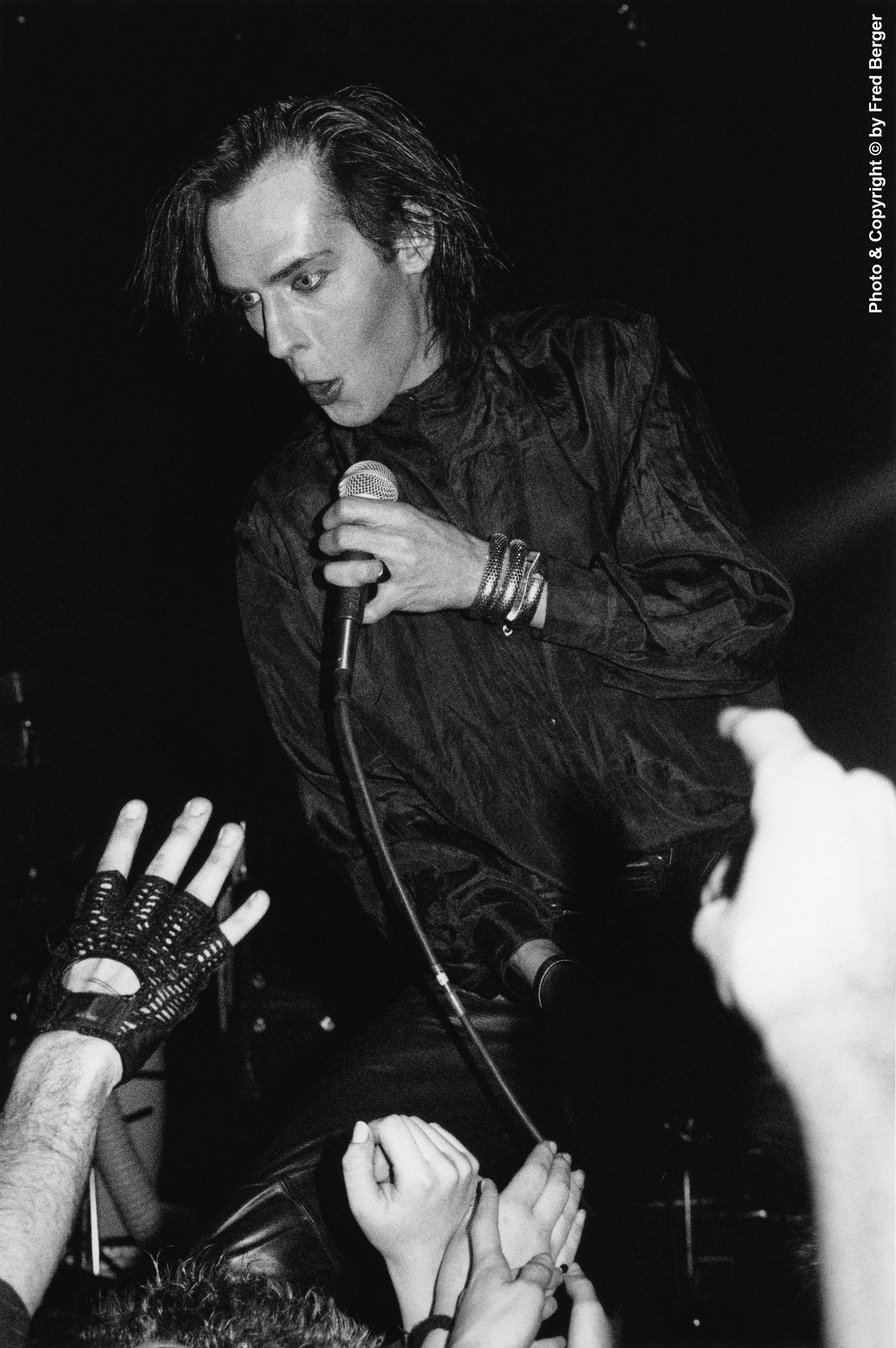
Saint Valentine’s Day, Feb. 14, 1987, marked the triumphant return of Peter Murphy to the stage after a four-year absence. His appearance at the Ritz concert hall in Greenwich Village, New York City was part of the U.S. tour to promote his first solo album, If the World Should Fail to Fall Apart. And what better time to perform for his adoring fans than on the most romantic holiday of the year. It was a packed house, filled with his black-clad minions come to pay homage to the Godfather of Goth, a moniker he had earned as the charismatic frontman of Bauhaus from its inception in 1979 to its breakup in 1983. The long hiatus had created an atmosphere of pent-up anticipation, and when their idol made his entrance mass hysteria ensued. The show opened with the song “Blue Heart” from the new album, but Peter did not fail to play some Bauhaus favorites, including a particularly apropos song for the occasion, “The Passion of Lovers.” He was in top form, prancing through the dry-ice mist and stark lighting, drawing on his pre-musical career as an erotic dancer, and employing experimental modern dance techniques. Dressed in a black silk poet shirt and leather trousers, his attire was more demure than the thong or skimpy tights he sometimes wore in the Bauhaus days. Even so, his sex appeal and showmanship still caused some fans to lose control as they attempted to grab him whenever he strutted along the edge of the stage. As it turned out, he still had the power to melt the hearts of his swooning devotees, one of whom yelled, “He is God,” when the band ended the show with an encore performance of “Spirit,” the Bauhaus song with the closing chorus, “We love our audience.”
Siouxsie Sioux
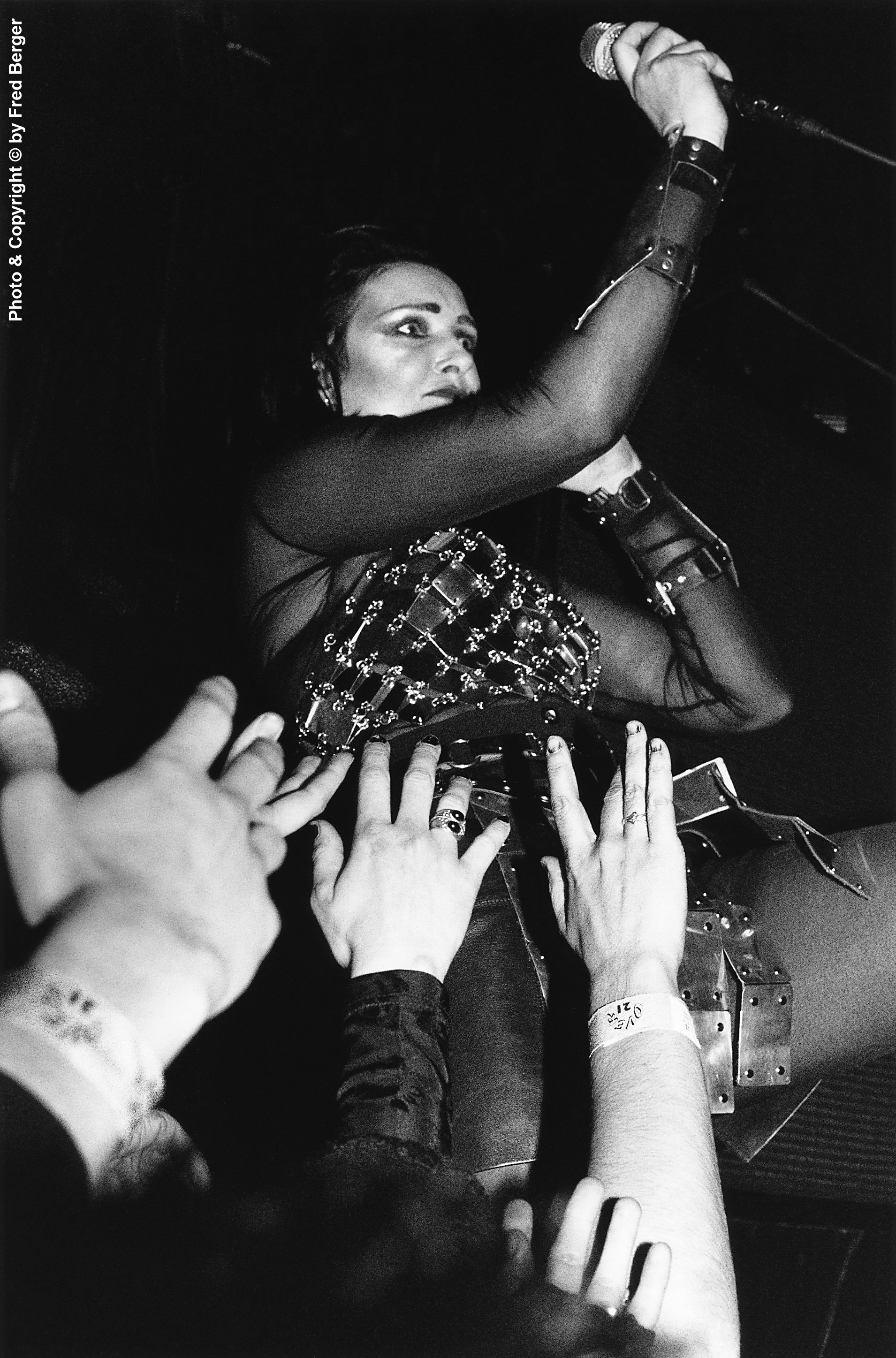
Two weeks prior to Halloween in 1988, Siouxsie and the Banshees marked their 13th year of melodious magic at Stoney Brooke University on Long Island, New York, which was one of many U.S. venues in their Peepshow tour. Gathered for the event were roughly a thousand devotees who waited on line for about an hour and a half in the midst of a violent thunderstorm, a meteorological phenomenon which is quite rare for this time of year in the American northeast. Doggedly, they endured the withering wind and rain, as if unleashed by a jealous Jehovah pouring out his wrath upon the heathen idolators worshipping at the altar of the Mother Goddess of Goth. But for every minute of climatic adversity they suffered, they were graced with a minute of enchantment courtesy of their most beloved chanteuse. The crowd exploded with excitement when Siouxsie took the stage, looking like a cabaret showgirl sporting a Louise Brooks bob cut and an all-black ensemble consisting of top hat, halter top, shorts, and thigh-high leather boots. Many at the edge of the stage frantically reached out to touch her with a fanaticism reserved to cult figures and living legends. The highpoint of the evening was the hit song “Peek-A-Boo” from the new album, with its offbeat and surreal rendition of the 1938 jazz number “Jeepers Creepers,” which brought down the house. Unfortunately, I didn’t record the event on film, because the ferocity of the storm deterred me from subjecting my camera to the elements, so I left it safely in the car. The only other time I had an opportunity to photograph Siouxsie up close in concert was at a Creatures show in 1999. One of the photos from that performance serves as a substitute image for this Siouxsie and the Banshees engagement, which I chose to write about instead, since this is the band that catapulted her to everlasting stardom.
Rozz Williams
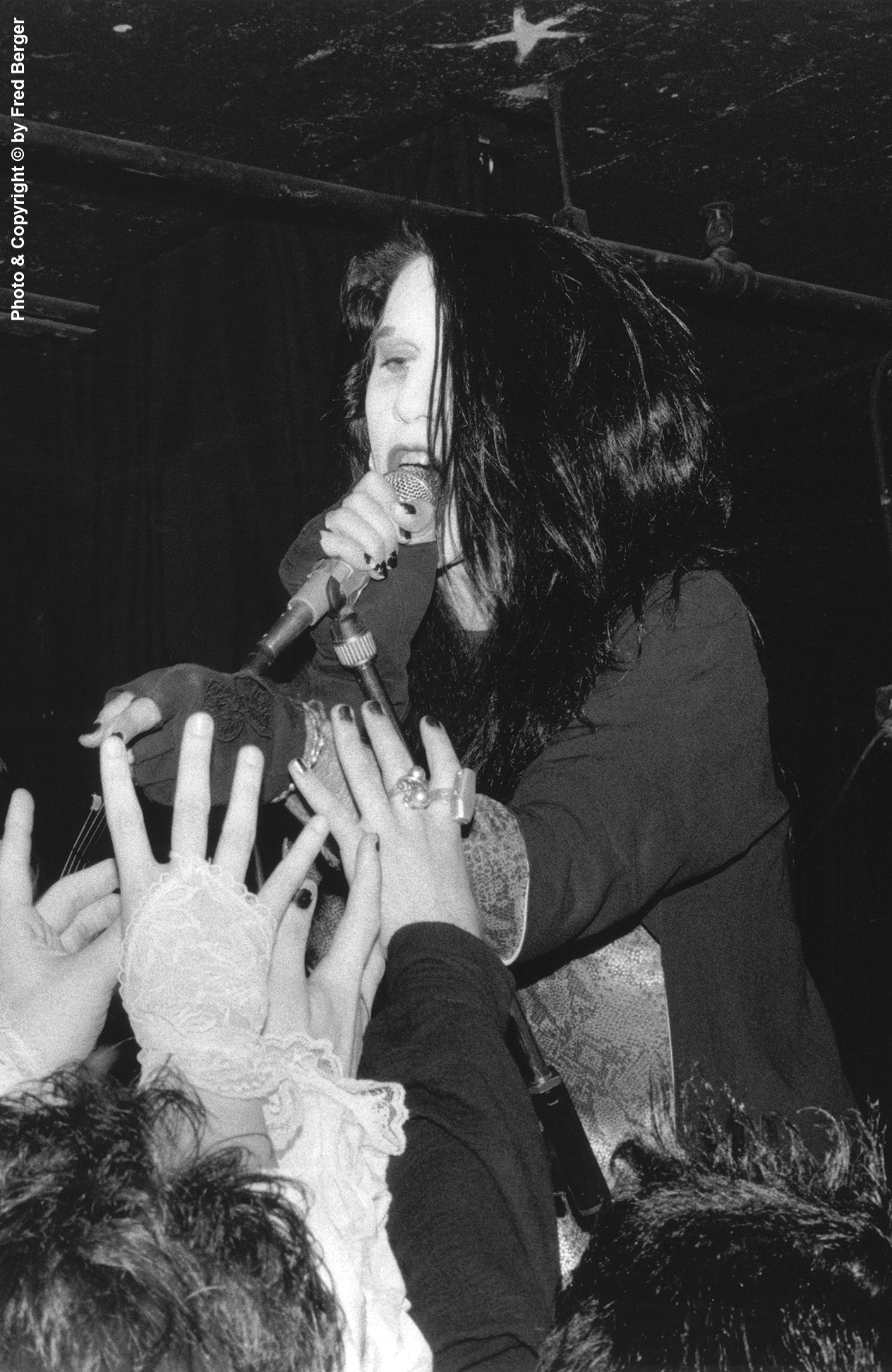
The Pyramid Club in the East Village of Lower Manhattan was the ideal venue for a group as splendidly dark and decadent as Shadow Project, the offshoot of the seminal L.A. deathrock band Christian Death. It’s reputation as a favorite haunt of drag queens, gays, and punks made it especially apropos for Rozz Williams, the group’s famously sacrilegious frontman known for his punk rock roots, queer persona, and penchant for crossdressing. Teamed up with the dynamic co-founder of the band Eva O. on guitar and the fetching femboy Paris Sadonis on keyboards, it was a combination sure to send gothic hearts aflutter. With severed mannequin limbs and Crosses hanging from the ceiling evoking the Spanish Inquisition, the scene was set for a night of blasphemy and blood. The gathered faithful were in an absolute frenzy, desperately clutching at their anti-messiah with longing and reverence. Songs from the group’s newly released 1991 self-titled debut album riveted the attention of the crowd, but several early ‘80s classics from Christian Death’s Only Theatre of Pain and Catastrophe Ballet LPs sent them into rapturous ecstasy. An air of such excitement was generated that after the show the backstage became a raucous party which went into the wee hours of the morning. But the merriment swirling around Rozz left him indifferent and distant, as if hopelessly jaded or in one of his heroin and alcohol induced dazes. Or perhaps he had a fleeting vision of the suicide that awaited him on April Fool’s Day in 1998, when he would be found hung from the neck in his West Hollywood apartment. Dead at 34 years of age, he would forever reign as the undisputed God of Deathrock.
Content © by Fred Berger
unique visitors